If Assad falls, Hezbollah will lose its
Syrian patron to the east—and its stranglehold on Lebanon. Could the
Jewel of the Levant rise again? And would it make peace with Israel?
Lebanon has a serious problem with Israel.
The country has technically been at war with its southern neighbor
since the Jewish state declared independence in 1948. Israeli citizens
are banned. Even foreigners are banned if they have Israeli stamps in
their passports. Lebanese citizens aren’t allowed to have any
communication of any kind with Israelis anywhere in the world. If
citizens of the two countries meet, say, on a beach in Cyprus or in a
bar in New York, the Lebanese risks prison just for saying hello. Israel
doesn’t even exist on Lebanese maps.
At the same time, with the possible exception of Morocco, Lebanon is
in important ways the least anti-Israel country in the Arab world.
Indeed, decades ago many Israelis assumed it would be among the first
Arab countries to sign a peace treaty with the Jewish state. It made
sense at the time. With its enormous one-third Christian minority (it
used to have an outright Christian majority), it’s the least Muslim and
most religiously diverse of all the Arab countries. And since a huge
number of its Christians insist they aren’t even Arabs, Lebanon might be
the least
Arab of the Arabic-speaking countries. Its capital,
Beirut, has more in common with Tel Aviv than with any Arab city,
including those in Lebanon itself. Put simply, Lebanon is just about the
only Arab country where Israel can find natural allies.
Decades ago, many Israelis believed Lebanon would be the first Arab country to make peace.
Yet today it is widely assumed that Lebanon will be the last Arab country to make peace with Israel.
To understand this paradox, you have to try to understand Lebanon. To
say Lebanon is a nation of contradictions is a cliché, but it’s a
cliché because it is true. It is simultaneously Western and Eastern,
Christian and Muslim, modern and feudal, democratic and illiberal,
secular and sectarian, cosmopolitan and parochial, progressive and
reactionary, tolerant and aggressively hateful. This is because there is
more than one Lebanon.
Lebanon is divided roughly into Christian, Sunni, and Shia thirds,
with a ten percent Druze population, as well. The Christians have had
ties with the West for centuries. Most of the Shiites look to Iran for
leadership and support. The Sunnis are generally aligned with the more
liberal and moderate forces in the Arab world, as well as with the
Saudis. Thanks to all of this, as well as Lebanon’s location between
Israel and Syria, Lebanon tends to get sucked into regional conflicts.
And because Lebanon was (and to some extent still is) a vassal state
of Syria, even discussing peace and normal relations with Israel can get
you imprisoned or killed. That’s been the case since the middle of
Lebanon’s civil war when international peacekeepers withdrew from
Beirut, and Syria’s ruling Assad family came to dominate Lebanese
politics.
Lebanon is a more-or-less free country that protects freedom of
speech, but on the Israeli question, it is effectively a police state.
Lebanese are afraid to talk to each other about it. They’ll talk to me,
though, because I’m an outsider. They’re extremely careful, of course,
and much of what they say is strictly in confidence, but once in a while
someone will talk to me on-the-record, knowing perfectly well that I’m
going to publish what they have to say.
I’ve been working in Lebanon on and off for eight years, and I’ve
noticed that things have changed since the Syrian revolution broke out
in 2011.
The red line on Israel isn’t as bright as it used to be. Except for
the usual warmongering rhetoric from Hezbollah, I sense more moderation
and sanity than I used to. It doesn’t surprise me. Peace between Israel
and Lebanon is still a long way off, but the possibility is now at least
conceivable, mainly because the end of Syrian tyrant Bashar al-Assad
will be the beginning of the end for Hezbollah. And they’re the ones who
enforce the red line on Israel.
This became clear to me when I had lunch with Mosbah Ahdab, a Sunni
politician and former member of parliament from Tripoli, Lebanon’s
second largest city.
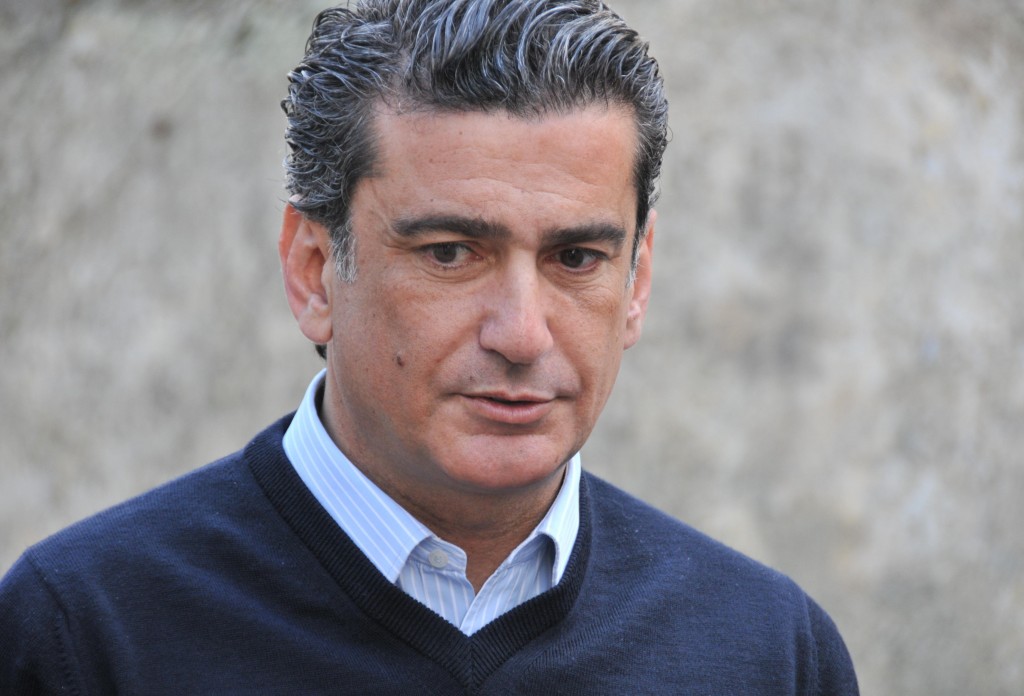
“We could have train service all the way down to Cairo.” Mosbah Ahdab. Photo: Michael J. Totten
“The post-Assad transition is going to be tough,” he said as we
shared a bottle of wine in his living room, “because we have Hezbollah
still around. But Hezbollah will be cut down to a more realistic size.
They will still have their weapons, but they can’t continue provoking
the tens of millions of people who live around here that they’ve been
aggressive to all these years.”
Indeed, Hezbollah will be surrounded by enemies. With the Assad
family out of power in Syria, Hezbollah will be left exposed as a Shia
minority in a Sunni majority region. Their immediate neighbors are Jews,
Christians, and Druze, none of whom have the time, patience, or
tolerance for an Iranian proxy militia in the eastern Mediterranean.
“There will be the real possibility of development,” Ahdab said. “We
could have train service all the way down to Cairo. It could be
fantastic.”
Michael Young, the opinion page editor of Beirut’s
Daily Star
newspaper, once said that Lebanon is a place where what isn’t said
matters just as much as what is. This was one of those times.
Look at a map: The only way a train can travel from Beirut to Cairo
is by passing through Israel. Lebanon and Israel will need an open
border and normal relations before something like that could even get
started. Yet a former member of parliament—not a Christian, but a Sunni
Muslim—is openly, if a little obliquely, discussing it.
But he can’t discuss it with the Israelis. He can’t talk about
anything with Israelis or he’ll go to jail. And he isn’t happy about that at all.
Ahdab can’t talk about anything with Israelis, or he’ll go to jail. And he isn’t happy about that at all.
“I was once invited to a European Union conference,” he told me. “There was an Israeli guy from the Web site
bitterlemons.net
sitting near me and trying to talk to me. There was a camera around and
I couldn’t respond. When the session started he said to the president
that he didn’t know why he was invited to a place where people from Arab
countries are present and refuse to speak with him. When it was my turn
to speak, I addressed the president. I said, the previous gentleman is
totally right. It’s ridiculous to be unable to communicate, but the laws
in my country forbid me from speaking to him. I’ll go to jail.”
I’ve heard lots of stories like this over the years from Lebanese and
Israelis. Israelis are offended when they run into Lebanese people who
refuse to acknowledge them, but Ahdab isn’t kidding when he says he’ll
go to prison. He used to be part of the government, but he’s afraid of
his own government’s laws. And if he had tried to change the law when he
was in the parliament, he almost certainly would have been killed by
Hezbollah or another of Syria’s allies.
I told Ahdab I think that law is insane.
“Absolutely,” he said.
But what if there’s a new regime in Damascus? What if, as he said, Hezbollah gets cut down to size?
Samy Gemayel, in a long-standing family tradition, serves as a
member of the Lebanese parliament. He’s the son of former President
Amine Gemayel and the nephew of Bashir Gemayel, who was Lebanon’s
president-elect in 1982 before he was assassinated. Samy’s brother
Pierre was an MP in 2006 when men wielding automatic pistols shot him to
death through the windshield of his car.
The Gemayels founded the Kataeb Party, which had a militia best known
as the Phalangists during the civil war of the 1970s and 1980s. It was a
hard-right party back then, but like most parties in Lebanon (except
for Hezbollah) it has mellowed with age. Today, the Kataeb has more in
common with European social democratic parties than with its militant
and ruthless old self.
I met Samy Gemayel in his office in the mountains above Beirut and
asked what he thinks might change in Lebanon without the Assad regime
next door, especially if it also means a chastened and weakened
Hezbollah. And, I added, “will there be any possibility that people
might at least start
discussing a Lebanese-Israeli peace track
with a new government in Syria? Nobody even talks about it now even
though Israel and Syria have negotiated repeatedly.”
“It’s a syndrome of the Lebanese people,” he said. “For twenty years
anyone who even opened his mouth and said we should think about having a
peace treaty with Israel went to prison or was killed.”
That was because of the Syrians and Hezbollah.
“People are afraid,” he said. “It’s like someone who has been in
prison for thirty years. When he gets out of prison, he’s afraid to walk
on the street and talk to people. It’s the same for the Lebanese
people. They haven’t gotten over this syndrome. Especially since
Hezbollah is here to remind them.”
A peace treaty is a long way off, of course, and will certainly
require the destruction or transformation of Hezbollah before it can
happen. But the first step will be getting over this syndrome and
dissolving the red line. And there may be a relatively simple way to
accomplish it.
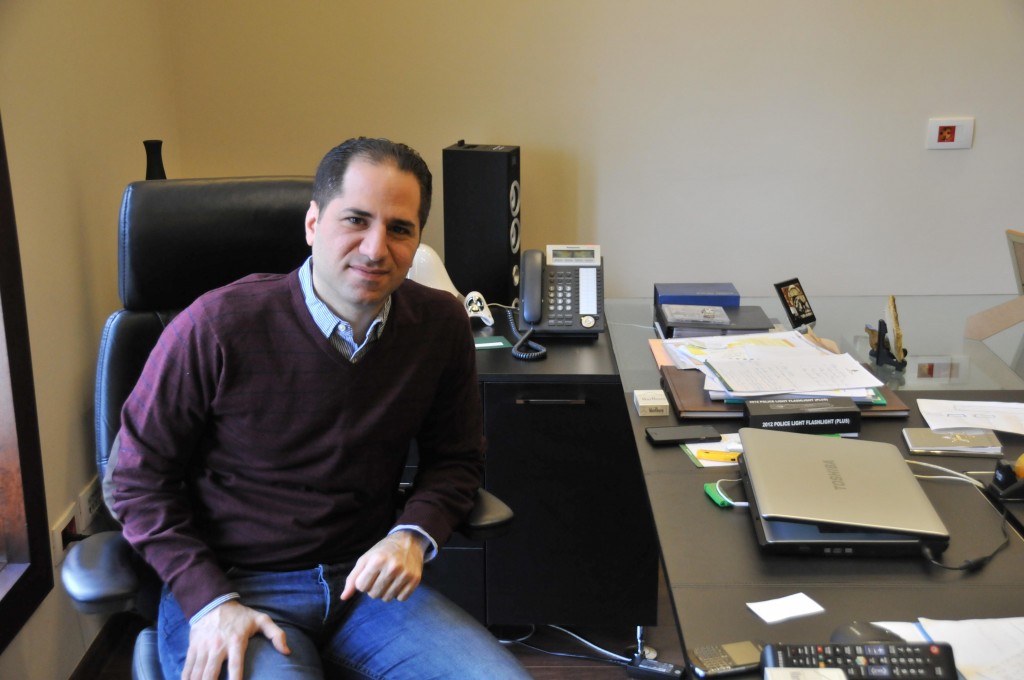
“Like someone who has been in prison for thirty years.” Samy Gemayel. Photo: Michael J. Totten
“What if,” I said to Gemayel, “people from Washington came here and
said, ‘Hey, you need to talk to your neighbors.’ Would things change?”
“Yes, it can change,” he said.
And why shouldn’t it? The syndrome is simple. It’s based on fear,
silence, and punishment. If the United States pressures Lebanon to
negotiate with Israel, the Lebanese will at least be able to discuss the
fact that they’re being pressured by the United States to negotiate
with Israel. And those who think it’s a fine idea will be given
international cover. Just as the red line was imposed from the outside,
it can be erased from the outside.
Indeed, powerful Lebanese people are walking right up to the red line right now without pressure from outside.
“Remember,” Gemayel said, “when Hezbollah had indirect talks with
Israel through the Germans? I went on TV. It was the first time someone
talked about this. I said, ‘how come Hezbollah is allowed to talk to the
Israelis indirectly through the Germans to get their prisoners back
while the Lebanese state is not allowed to do indirect talks like
Hezbollah to get back Shebaa Farms?’”
Hezbollah didn’t respond to that challenge. What could they possibly say?
“We really don’t have anything to hide,” says Samy
Gemayel. “We believe there should come a day when we negotiate with
Israel in order to have permanent peace on our southern borders. We
should end this. We should have stability.”
The Gemayels and their party were allied with Israel during Lebanon’s
civil war. Samy Gemayel’s uncle, Bashir, swore to vanquish Yasser
Arafat’s Palestinian state-within-a-state in southern Lebanon, to throw
out the Syrian army, and to sign a peace treaty with Jerusalem.
Naturally the Israelis backed him to the hilt in 1982 when they invaded
and he was elected president.
According to Thomas Friedman’s account in his book,
From Beirut to Jerusalem,
one of the last things Bashir Gemayel ever said was, “To all those who
don’t like the idea of me as president, I say, they will get used to
it.” A few moments later, he was blown to pieces by terrorists from the
Syrian Social Nationalist Party.
Bashir’s brother Amine replaced him as president. Lebanon’s civil war
raged on—it was only half-way through at that point. And the Kataeb’s
alliance with Israel began to wane. Jerusalem’s peace partner was dead
and replaced with his more cautious brother. Hezbollah was on the rise
in the south—from which Arafat’s PLO had been evicted—and in the
northern Bekaa Valley. The Assad regime’s military forces weren’t
planning to leave Lebanon anytime soon. The Israeli dream of a friendly
and terrorist-free Lebanon was premature and would have to be deferred
for a generation at least.
I asked Samy Gemayel about his party’s former alliance with Israel,
and I did it carefully. “You can answer me twice,” I said, “on the
record and off the record. I can turn off my voice recorder because I
want to know what you
really think, but I also want to know what you would say publicly.”
“Let me be very clear,” he said, “and this is my answer publicly and
non-publicly. We believe we had no choice back then but to have an
alliance with Israel. I’ve said it on TV. And if we find ourselves in
the same position today, we would do it again. I also said that on TV.
We couldn’t do anything else. The Syrians were against us. The
Palestinians were against us. The Lebanese Muslims were against us. The
entire Arab world was against us. What were we supposed to do? Say,
please kill us? We would take support from anywhere, and the only
country that supported us at that time was Israel. We really don’t have
anything to hide on this matter. And we believe that there should come a
day when we negotiate with Israel on all pending and disputed issues in
order to have permanent peace on our southern borders. We should end
this. We should have stability.”
He went on. I thought he might be careful and cautious, that he’d
rather discuss something else, but no, he walked right up to the red
line and told me I could print all of it.
“There is no excuse,” he continued, “why Egypt is allowed to have a
peace treaty with Israel while we cannot negotiate for an armistice. Why
can Jordan have a peace treaty while we also cannot negotiate for an
armistice? Even Syria, without a peace treaty, has had peaceful
relations with Israel since 1974. Why can’t we? More, why can Hezbollah,
a paramilitary group, negotiate with Israel twice through German
mediators in 2004 and 2009 to release its prisoners, and the official
Lebanese state is not allowed to?”
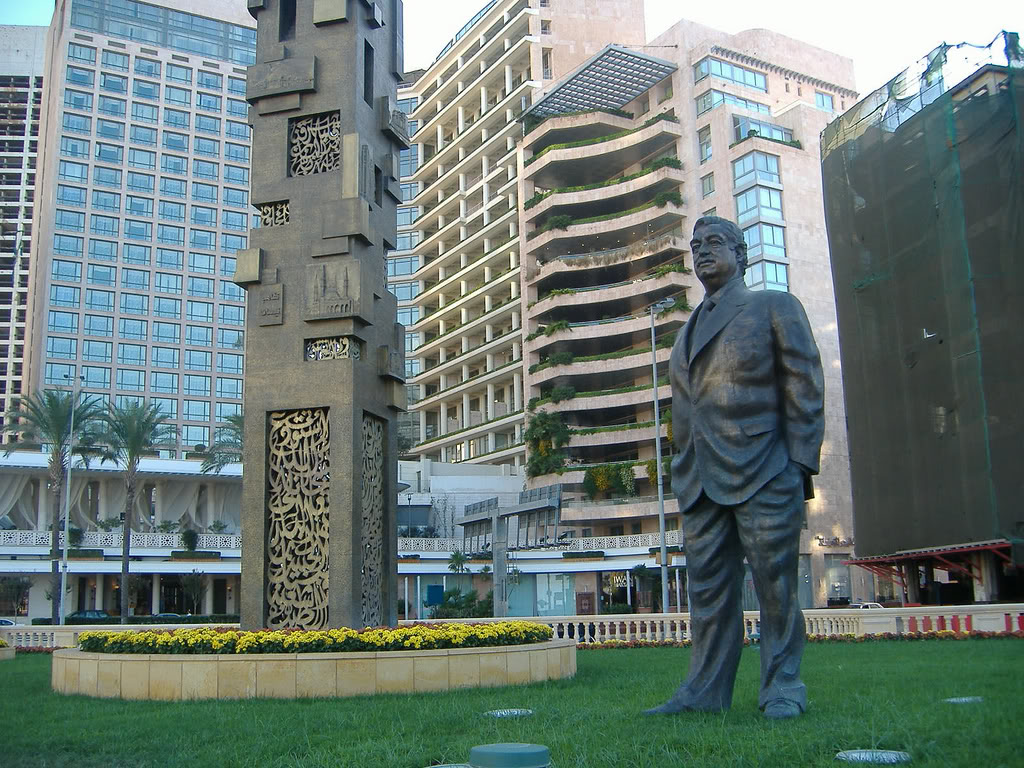
Memorial for the assassinated Prime Minister Rafik Hariri. Photo: Wikimedia
How many Lebanese people agree with Gemayel? Who knows? They aren’t
really allowed to discuss it. There certainly aren’t any polls on this
question, and they wouldn’t be reliable if there were.
When I asked how many people he
sensed agreed with him, he
put it this way: “We have to take into consideration that a lot of
people were killed here by Israel. We have to be very careful when we
talk about it because people died. But it’s the same for Syria. Syria
also killed a significant number of Lebanese from 1976 onward; more than
what Israel killed, it may be argued. So if you want to have this
attitude toward Israel, why not have the same toward Syria? Syria has
done more harm to Lebanon than Israel.”
There are two reasons it’s considered acceptable to be a Lebanese
ally of Syria but not of Israel. First of all, Syria is a “brother” Arab
country. And second, Syria conquered Lebanon, transformed its political
system, and still has agents and proxies inside.
“We just want peace in this country,” Gemayel said. “We want to build
this country that has been destroyed for the last forty years. And we
can’t build this country as long as it is at war. We don’t want to be at
war anymore. It’s as simple as that. The future should be a future of
peace.”
The Future Movement party, founded by the late Rafik Hariri—who was
assassinated in 2005 by the Syrians and Hezbollah, kicking off the Cedar
Revolution—is the primary political vehicle for Lebanon’s Sunni
population. It gets roughly 90 percent of the Sunni vote in elections.
(The local Muslim Brotherhood is an irrelevant fringe party.) Hariri
essentially agreed with Gemayel, and so does his son and successor,
former prime minister Saad Hariri. The Future Movement, as its name
implies, looks to the future and not the past. Its ideology is one of
liberalism and capitalism, which cannot flourish in war zones. Neither
Hariri campaigned for peace with Israel, but neither waged war
on Israel either. Instead, both struggled against Israel’s regional
enemies. And they paid the price, the elder Hariri with his life and the
younger with self-imposed exile in France.
I had dinner with Saad Hariri shortly before he became prime minister
in 2009, and though I can’t quote him directly because our conversation
was off-the-record, I can say that this man, who is the leader of
Lebanon’s Sunnis, isn’t an obstacle to peace.
What about Lebanon’s Shia? They make up roughly a third of the
population, and roughly two-thirds of them are at least nominal
supporters of Hezbollah. But another third or so are staunchly opposed
to the party.
Lokman Slim is the Shia community’s most prominent anti-Hezbollah activist. He lives right under the Party of God’s nose in the
dahiyeh,
Hezbollah’s stronghold in Beirut’s southern suburbs. He has dedicated
his life to building a liberal alternative to the self-proclaimed “party
of God.” His opinions are his own. Politically, he’s a minority figure.
But he’s not at war with his community. He is at war with its dominant
political party, which is not the same thing at all.
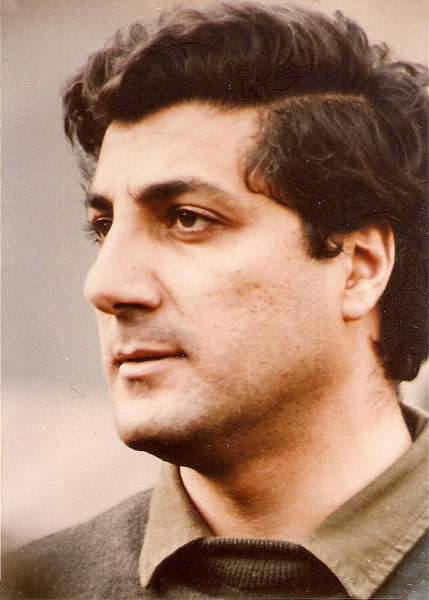
Lebanon’s lost hope.
Prime Minister Bashir Gemayel.
Photo: Wikimedia
“The Shia want to be a respected partner in the globalization of the
world,” he told me. “I can’t accept that the shitty island of Cyprus is
part of the European Union and we, just a few miles away, are
ostracized. We want to enjoy prosperity and suffer recessions, to be a
part of the world with all its problems and all its benefits. We want to
be part of the world like Israel and Syria.”
How many people in the Shia community agree with what he is saying?
“Much more than you think,” he said.
Lebanon is one of the few Middle Eastern countries not ruled by a
monarch that never went through a socialist phase. Even Israel went
through a socialist phase, though fortunately not on the Arab or Soviet
model. Capitalism and trade come naturally to the people of Lebanon.
They don’t have much choice. It’s a small country without any resources.
Even after decades of military occupation and war, Lebanon is more
prosperous than the other resource-poor Arab countries. Wouldn’t its
economy heat up if Beirut had a peace treaty and free trade with Israel?
“Obviously,” Slim said. “We should take advantage of the fact that
people want peace. Don’t only listen to [Hezbollah leader] Hassan
Nasrallah. Talk to people in the street. The people in the south will
tell you they want peace while Nasrallah always says he wants war. Of
course the old woman in her shop selling cigarettes and sandwiches to
UNIFIL soldiers wants to expand her small business.”
He wasn’t referring to any old woman in particular, but there are
plenty of merchants in the south who have done business with the
Israelis, and not all of them are in their seventies. When Israeli
soldiers invaded southern Lebanon in 1982 to demolish Yasser Arafat’s
PLO statelet, the indigenous Shia population hailed them as liberators.
Hezbollah doesn’t talk about this, and the party is extremely unhappy
when anyone else brings it up, but everyone in Lebanon knows it’s true.
At the time, it did not even occur to Lebanon’s Shia that Israel was
their enemy. Their foe was an ancient one, which had been kicking them
around since just after Islam was created—the Sunnis. Palestinians are
overwhelmingly Sunni, and in the 1970s their construction of a
belligerent mini-state in the Shia heartland of south Lebanon was a most
unwelcome development.
“The Shia of the southern hinterland,” wrote Johns Hopkins professor
Fouad Ajami, who himself hails from that part of Lebanon, “had endured
Palestinian power, the rise in their midst of a Palestinian state within
a state. The Palestinian gunmen and pamphleteers had had the run of
that part of the country. Arab nationalists in distant lands had hailed
that Palestinian sanctuary; Arab oil wealth had paid for it. The Shia
relief in 1982, when Israel swept into Lebanon and shattered that
dominion, was to the Arab nationalists proof that the Shia stepchildren
were treasonous. Then a Shia militant movement, Hezbollah, rose to
challenge Israel. Its homicide bombers, its policies of ‘virtue and
terror,’ acquitted the Lebanese Shia in Arab eyes.”
But it took years for Hezbollah to convince the average Lebanese Shia
civilian that they were the good guys. If the Israelis had not stayed
too long in southern Lebanon—the occupation lasted almost two
decades—Hezbollah would have had a much harder time getting started.
“The Shia peasants denounced Hezbollah to the Israelis,” Slim said.
“They would go to the Israeli soldiers and report strange things that
were happening. Hezbollah spent a long time changing the mentality of
these people.”
If Hezbollah is weakened or collapses entirely, this mentality should
eventually revert to the norm, because Jews have never been the
principal enemy of the Shia. That dubious honor has always gone to the
Sunnis. And as Ajami points out, the Shia “resistance” against the
“Zionist entity” was from the start as much about acquiring status and
respect, and thus acceptance, from the Sunnis as it was about Israel.
“Go to the south,” Slim said, “and ask people if they want a new war, another divine victory.”
I have, and they say no. Lebanon’s Shia are simply not interested in
war any more. The Second Lebanon War in 2006 was the high water mark in
support for Hezbollah aggression. Nasrallah himself was forced to admit
it. He all but apologized to his community in the smoldering aftermath,
saying, “If I knew the process of capturing [Israeli soldiers], even
with a one percent probability, would lead to a war like this, and then
if you asked me would you go and capture them, my answer would be, of
course, no—for humanitarian, moral, social, and security reasons.”
Sign in East Beirut. Photo: Michael J. Totten
Obviously he wouldn’t have said that if his constituents had enjoyed
his destructive adventure. But that doesn’t mean they want a peace
treaty and normalization. They don’t.
“They want a cold peace,” Slim said. “Right now they are
ideologically conditioned. Don’t forget all the anti-Jewish propaganda.
Because we’re not just talking about Israel. Anti-Semitism has been
rooted in our culture from the nineteenth century up through Hezbollah.
So people in the south just want a cold peace. They will not mind taking
advantage of a warmer peace, but don’t involve them in its creation.”
Hanin Ghaddar, the managing editor of the online magazine
NOW Lebanon,
is another liberal Shia from the south who dissents from the mainstream
opinion in her community, and she’s free to say things Hezbollah and
its supporters will not.
“People had different opinions,” she told me, “but the general
impression was that the 1982 Israeli invasion was great. The Israelis
overstayed their welcome, but they were
really welcome at the
beginning. Everybody was very happy. I remember it. A lot of my
relatives were happy, including my father. We had no problems with the
Israelis.”
But they expected the Israelis to leave. The strangers from the south
were welcome as liberators, but not as occupiers. If they had left,
Hezbollah would have had a much harder time establishing itself. She
concurs with Lokman Slim. Hezbollah, she said, “used the occupation to
rally the people around them.”
The Israelis should have left sooner, but the error is perhaps
understandable. They were welcomed at first, so they thought they’d be
welcome to stay. And they wanted to stay to prevent another hostile
group like the PLO establishing itself on the border. Obviously, it
didn’t work out.
But anti-Zionism was not an indigenous belief in this part of
Lebanon. The Israelis didn’t foresee that Iran’s revolutionary new
government would export its ideology to its distant coreligionists,
partly because Iran’s ambitions in the Levant had not yet taken shape,
and also because the Shia history of dispossession and neglect was
not—and still is not—widely understood in Israel. The Iranians
understood it, however, because it is their story as well. The rise of
Hezbollah was welcome among the Shia for the exact same reason the
Israeli invasion was welcome—both promised relief from Sunni oppression,
both ancient and modern, both real and imagined.
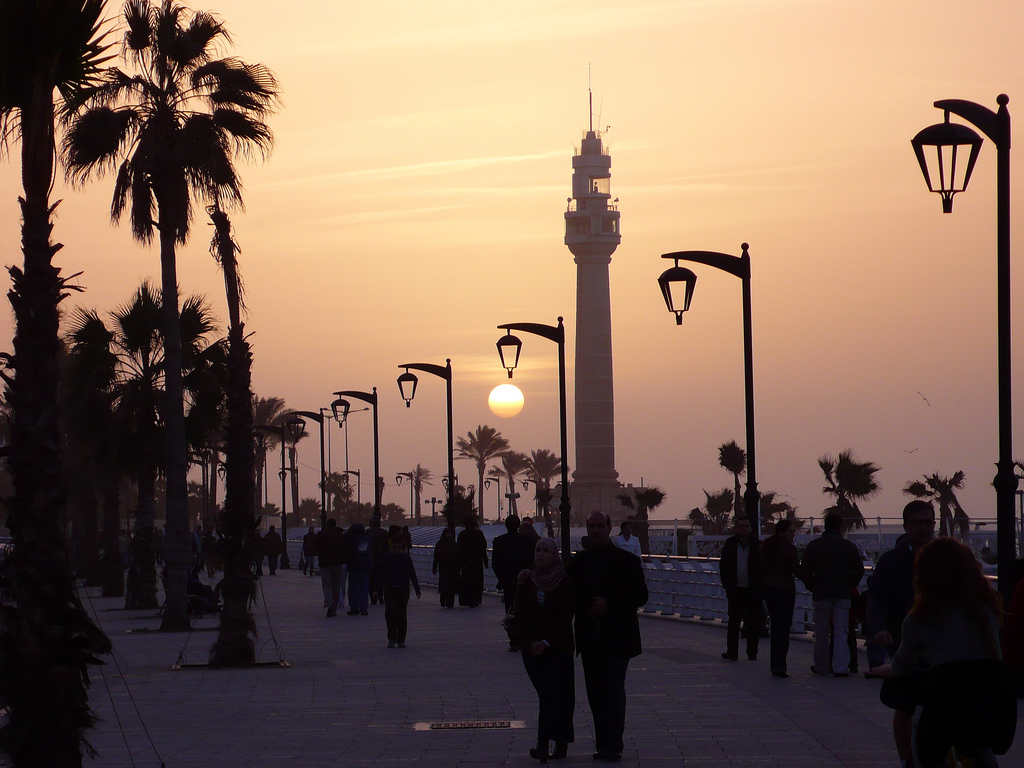
Dreaming of a better Lebanon. Beirut at Night. Photo: Charles Nouyrit / Flickr
Ghaddar lives in Beirut, but she grew up in the south and often
visits family there. Like Slim, she’s convinced her community will be
more relaxed on the question of Israel in the future.
“They’re very flexible, she said. “The war with Israel ended in 2006.
Everybody knows that. It’s not going to happen again, not if Israel
doesn’t start it. Hezbollah cannot strike first again. They don’t have
enough support. For the people, the war is over. They’re convinced
Israel isn’t going to strike unless Hezbollah starts something.”
None of this means peace and normal relations are around the next corner, but what about relative peace and quiet?
“There is a way,” said Eli Khoury, CEO of the M&C Saatchi
advertising company in the Middle East and co-founder of the Lebanon
Renaissance Foundation. “Hezbollah has already agreed in principle to
return to a non-aggression treaty, the original armistice that has been
in place for more than 60 years. [Druze leader] Walid Jumblatt campaigns
for it. [Former prime minister] Fouad Seniora also campaigned for it.”
He’s referring to the armistice the Lebanese government and the new
State of Israel signed at the end of the first Arab-Israeli war in 1949.
Lebanon was hardly even involved in that war, and hasn’t actively waged
war against Israel since. The Israelis have fought in Lebanon, but not
against the Lebanese army or government. Their enemies were Palestinian
and Iranian-backed terrorist organizations. In the middle of the 2006
war, Lebanese and Israeli military officers sat down over tea and worked
out a plan to ensure that neither side accidentally shot at the other.
“Everyone is at least paying lip service to neutrality now,” Khoury
said. “It used to be only the Christians who said they wanted
neutrality. So today at least lip service is paid by every party, even
the harshest, to neutrality, decentralization, border control, cleaning
up agreements with Syria, and a return to the armistice with Israel.”
It’s true that the Christians have always wanted Lebanon to be
neutral in the Arab-Israeli conflict. The Shias wanted it, too, until
1982. Back then it was only the Sunnis who wanted Lebanon involved. It
was they who embraced Egyptian tyrant Gamal Abdel Nasser’s pan-Arabism
and invited the PLO into the country.
Since then, however, the Sunnis in Lebanon have quietly moved on from
the conflict with Israel, just as Sunni Arabs have moved on pretty much
everywhere else. For them, the war ended with the PLO’s last stand in
1982. As for the rest of the region, not a single Sunni Arab government
has actively participated in a full-blown war against Israel since the
1973 Yom Kippur War. Lebanon’s Sunnis, in moving on, are hardly unique.
Indeed, they have even more reason to move on than do Sunnis in places
like Tunisia and Morocco, because Tunisia and Morocco don’t get torn to
pieces when the rocket launchers are fired up. Contrary to popular
belief in some quarters, most Lebanese people do not enjoy getting blown
up and shot at.
“The most recent study we commissioned,” Khoury said, “and it was
thorough, we surveyed 4,000 people, showed that 95 percent of the Sunnis
don’t care about Salafism or the Arab-Israeli conflict anymore. They’re
interested in other things. You have to remember that Saad Hariri’s
party is by far the most popular movement among the Sunnis.”
Only Hezbollah keeps the fight alive, and historically speaking, the
default position of their constituents has been radically different from
what it is now. Hezbollah’s sponsors in Syria and Iran are still
standing, and it might take a generation for attitudes to change even
after guns, money, and ideology stop coming in from Tehran and Damascus.
But it should be clear by now there’s nothing
eternal about
the attitudes and behavior of Israel’s northern neighbor. And if it’s
still too soon for optimism, it is not too soon to say that there
appears to be at least some light at the end of the tunnel.